Showing posts with label Gamboa. Show all posts

Sunday, September 8, 2013

A Big Boa in Gamboa

You never know what you're going to find here, Gamboa is full of surprises.  Being surrounded by Soberania National Park, the Panama Canal and Chagres River, the wildlife here is abundant.  Even right in town, where it is not difficult to find frogs, lizards, birds, interesting insects and more.  

There are many snakes around town, but aren't encountered as frequently as a lot of the other animals, not by me anyways.  However, the other day, I was heading out of town with a friend when we passed a truck pulled over on the side of the road and two men with cameras pointed at the grass.  Then I took a quick glance, and saw a large Boa Constrictor!  So we pulled over and got out to take a look.  
Boa Constrictor
Boa Constrictor 
Boa Constrictors are a well-known snake native to the lowland tropical forests of Central and South America.  They are a large, heavy-bodied snake that can reach up to 4 metres in length and can weigh more than 100 lbs.  As their name suggests, they are "constrictors", killing their prey by wrapping their strong, muscular body around their prey, slowly squeezing them to death.  They hunt just about anything they can catch, such as monkeys, otters, birds and peccaries.  Boa Constrictors are hunted for their ornately-patterned skin and due to other pressures including habitat loss, they are considered an endangered species in many countries.  

This snake looked like it had just eaten a good meal, perhaps an agouti it found in town.  As it sat on the grass, this boa was being pestered by people and dogs, at which it defended itself well.  Eventually, with a rainstorm around mid-day, the snake retreated out of sight, back into the woodlot.  To me and a lot of other people I know, snake sightings are always exciting.  We have to give these graceful, capable reptiles more credit as they play an important role in their environment.  I'm always looking forward to the next snake I see...

~ Jenn 

Wednesday, August 7, 2013

Cool Caterpillars and their Defenses

Next to birds, insects are a very fascinating group of animals to me.  Especially lepidopterans - butterflies and moths.  I don't know what it is I like about them so much - their beauty, diversity, adaptations, an interest to follow their classification, and I really enjoy the challenges of identification.  Furthermore, they have changes in their life cycle that make it all the more fun to identify.  They undergo complete metamorphosis and their larvae, better known to us as caterpillars, are physically diverse with a wide variety of adaptations and defenses themselves.  So needless to say, wherever I am, coming across caterpillars is always entertaining for me.  

We recently went for a walk in Gamboa on a nice breezy afternoon after a rain.  As I now always try to have my camera with me, we stopped to photograph a sedge, of all things!  There is a species of sedge here, superficially resembling a grass, that appears to have been spray-painted the tops, which spread out in 3-6 blades, with the colour white.  Plants are not my strong point, so if anyone can help me with its identification, it would be much appreciated!  They are particularly pretty, so worth a stop to snap a few photos.  
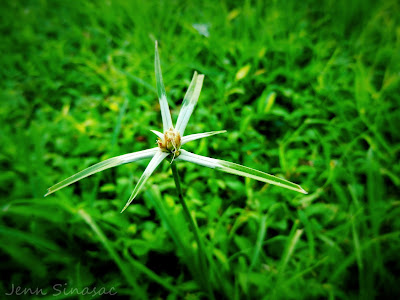
Grass
After I got some photos, we noticed something hanging off a small papaya tree planted in the boulevard.  Upon closer investigation, it was a caterpillar, hanging off one of the papaya leaves.  At the base of the tree, there were two more.  These caterpillars were large, up to 10 cm long, and had a "horn" protruding from the back of its abdomen, a characteristic of "hornworms" or Sphinx moth caterpillars, in the family Sphingidae.  This is the larva of Alope Sphinx, Erinnyis alope.  This widespread species ranges from extreme southern United States through the tropical regions of Central and South America and the Caribbean, and even has a subspecies endemic to the Galapagos Islands!  The caterpillars feed on papaya, which was a nice confirmation of its species.  When in its dark phase, it is similar in appearance to Errynis ello, which rather feeds on pointsettia. 
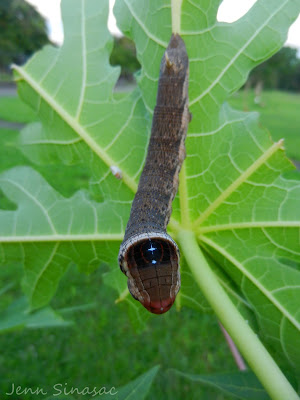
Alope Sphinx Caterpillar (Errinyis alope)
Alope Sphinx caterpillar, Errinyis alope
Alope Sphinx Caterpillar (Errinyis alope)
Alope Sphinx caterpillar, Errinyis alope
Furthermore, to get a closer look at these larvae, we moved the leaf around and the caterpillar, alarmed, widened its thorax, which was a darker color than the rest of its body, and had a unique, white "starburst" marking, perhaps even resembling an eye.  It protruded its thorax, and reminded me of a caterpillar I saw posted on Facebook a few months ago of an Elephant Hawk-moth Caterpillar (Deilephila elpenor) from Europe & Asia that, when startled, can change its thorax to resemble the head of a pit-viper.  Its head is actually tucked under its body when it is in this defense position.  
Alope Sphinx Caterpillar (Errinyis alope)
Alope Sphinx caterpillar, Errinyis alope
While watching the caterpillars on the small papaya tree, we couldn't help but worry about their conspicuous appearance (being so big they were not difficult to see), and that they would be particularly appetizing to a passing thrush or antshrike.  Caterpillars evade predation in a number of ways, and depending on the species, have a variey of effective defenses, from resembling snakes and bird poop, to either exposed or concealed stinging spines containing potent toxins, toxic urticating hairs, aposematic (warning) coloration to announce to any potential predator that it would not be a tasty snack.  Check out this article for more examples of caterpillar defenses (and good photos).  By rearing up and showing off that large 'eye', perhaps this is how Errinyis alope avoids being eaten.  

A Caterpillar Warning: 

When growing up, I remember playing with caterpillars in my backyard.  Down here in Tropical America, I think twice about every caterpillar I see, and as a general rule, do not touch!  On more than one occasion, I have suffered stings from tropical caterpillars (however, stinging caterpillars are not restricted to the tropics, and can be found in temperate regions as well), and it is not a pleasant experience.  Caterpillars that sting and have urticating hairs can be quite toxic, and reported cases of human deaths due to caterpillar stings are not unheard of.  Just a word of advice and worth keeping in mind if traveling to the tropics, its a wild world down here, and creatures like caterpillars may not always be as friendly as they seem.  That being said, they are still cool to come across! 

~ Jenn 

Sunday, July 21, 2013

Lesson Learned - Always Bring a Camera!

I enjoy bird-watching, wildlife-watching and finding fascinating creatures and plants.  Furthermore, I enjoy documenting what I find through taking pictures.  I don't have a big, fancy, high-quality camera, but my compact Nikon Coolpix S9100 with 18x zoom does a pretty good job sometimes, and I try to have it with me at all times in case I come across something of interest, which often happens here.  

Two weeks ago, I went for a walk on a gloomy Sunday morning in Gamboa before heading to work.  It's the rainy season, and the sky was heavy with dark clouds and mist.  I didn't want to risk damaging my camera with imminent rain, so I left it at home this time - big mistake!  As I was walking behind the Gamboa Rainforest Resort, a large white bird flushed up out of the marsh into a Cecropia tree.  It was a beautiful adult Capped Heron, a rare species that occasionally presents itself in central Panama.  The clouds had started to lift, and this shy bird sat in good view, in good light, for approximately 5 minutes.  I considered running back home to grab my camera to grab some photos of this stunning heron, but I realized that even better, I could spend valuable time enjoying watching the bird.  Although I really enjoyed watching this bird, my favourite heron, of which I have not seen in years since volunteering in Amazonia Peru in 2007, I still wished I could have gotten some photos!

Yesterday, while out for another short walk on a gloomy rainy day, I decided to leave my camera at home, again.  The bird life was surprising quiet after the heavy rain, but I continued to enjoy the walk.  As I passed a streetlight along the road, I looked up on the lamp and a leaf-like shape caught my attention on the other side.  I took a second look, and it wasn't a leaf stuck there after the rain but a beautiful Rothschild's Moth (Rothschilidia sp.), one of the largest silk moths in the Americas, and resembles the Atlas Moth (Attacus atlas) of southeast Asia.  I was mad at myself for not having my camera, again!  Figuring it would be resting there for a while, I walked home, grabbed my camera and went back to grab some photos.  
Rothschild's Moth

Rothschild's Moth
Rothschild's Moth (Rothschilidia sp.)
Maybe I tend to find the coolest things when I do not have my camera with me; regardless, I do not want to miss future opportunities, as here, you never know what will show up!  I have learned my lesson, and even in the wet season, I will always try to have my camera with me (and some plastic bags to keep it dry if it rains!). 

More to come on my week of bird banding in Costa Rica!

~ Jenn


Friday, June 14, 2013

Agoutis & Avocados

One of the many glorious things about living in Gamboa is the fruiting tropical trees.  In any given garden in Gamboa, you may find papaya, mango, pineapple, coconut, maranon (cashew trees), avocados and more.  Avocados are my favourite, and in June, the heavy fruits fall from the trees in mass quantities.  There is one catch though, you must beat the agoutis to them.  
Central American Agouti
Central American Agouti, Dasyprocta punctata
Agoutis are (normally) rather shy members of the rodent family, and several species are found throughout Central and South America.  In other places I have been such as Peru and Ecuador, they are seldomly seen, quietly moving across the forest floor and eating seeds and fruits they seek out.  They resemble a small Capybaras, with a rounded snout, short ears, short tail and thin peg-like legs.  But here in Gamboa and central Panama, agoutis are very common and remind me more of our neighbourhood squirrels back at home in Canada.  They graze in the gardens and sports fields.  They chase each other around obstacle courses of trees and street signs.  The sit on their haunches in the middle of the streets and eat fruits.  They are quite the sight.  They also are very good at seeking out fallen avocados.  

Avocado

So these days, as the avocados are dropping daily from the trees in my backyard, I am keeping a close ear open.  As soon as I hear one fall, I must get to it before the agoutis do.  If I'm tied up with something and can't make it out there right away, I will lose my chance.  By the time I get out there, it may already be partially eaten by the cheeky agoutis!  

~ Jenn 

Tuesday, June 11, 2013

More big beetles!

In April, I had come across a large male Harlequin Beetle, Acrocinus longimanus, a beautiful longhorn beetle with ornate markings, at the Canopy Bed & Breakfast in Gamboa.  A few days ago, again at the B&B, I found another large beetle lying on its back under the house.  This time, it was an Elephant Beetle!  This was early in the morning and it had been attracted to the lights of the B&B at some point overnight.  I helped the struggling beetle right itself, then, as I have learned not to go anywhere without my camera, placed it on a stick to take some photos.  
Elephant Beetle
Elephant Beetle
The Elephant Beetle, Megasoma elephas, is a large, heavy-bodied beetle of Central and South America.  It is a member of the Scarabaeidae family, a large family of beetles that includes the impressive Hercules Beetles, stag beetles, june beetles, dung beetles and many more.  Both male and female Elephant Beetles are black with a thick layer of microscopic hairs that make it appear a yellow or tan colour.  Males are 2-3 times larger than females, and have two prominent horns extending forward from their head and one from their prothorax, which are used for defense in competition for food and mates.  Elephant beetles eat sap, fruit (and are particularly fond of pineapple) and bark.  Their larvae are particularly large and live in decaying logs, taking up to 3 years to develop into adults!  The larvae are very large, c-shape and white or yellowish in colour.  Once the larvae pupate into adults, adults live for only one to three months.   
Elephant Beetle
Elephant Beetle
Always something interesting to find here!

~ Jenn     

Tuesday, May 21, 2013

Gamboa Garden

Yesterday we enjoyed a beautiful Sunday afternoon watching the hummingbirds and other wildlife just outside our doorstep.  A pair of Common Tody-Flycatchers (Todirostrum cinereum) have built a nest in the arbor outside the front door, and every day I've been watching these tiny birds tending to the nest.  Hoping for fledglings soon! 
Common Tody-Flycatcher
Common Tody-Flycatcher, Todirostrum cinereum
Common Tody-Flycatcher nest
Two freshly-filled hummingbird feeders attracted dozens of hummingbirds, including White-necked Jacobins, Rufous-tailed Hummingbirds, Violet-bellied Hummingbirds, Blue-chested Hummingbirds and a beautiful male Violet-crowned Woodnymph.  
Violet-bellied Hummingbird
Violet-bellied Hummingbird, Damophila julie
White-necked Jacobin
Female White-necked Jacobin, Florisuga mellivora
White-necked Jacobin
Male White-necked Jacobin, Florisuga mellivora
Reduviid nymphs
A cluster of young Reduviid bugs
Costus
Costus Plant
Looking forward to spending more time in the garden!  
~ Jenn 

Wednesday, February 6, 2013

Falcon misfortune

This morning I was up before dawn and headed out to the Panama Rainforest Discovery Center to enjoy the morning birds from the canopy tower there.  However, a mid-morning rain sent me home a little early than planned, where I started to settle in for the day.  

Shortly after arriving at home, I got a phone call from my housemate, who was out for a walk in Gamboa.  He said that he just witnessed a falcon hit a window at one of the houses in town and asked if I could come help.  I packed up a towel and headed out to see if I could be of any help.  I was expecting a Bat Falcon (common in town) or other raptor, but when I got there I was surprised to see a beautiful white-phase Collared Forest-Falcon sitting on the ground.  It had hit a large window, rather hard, and had been stunned on the ground.  After about 10 minutes, just before I got there, it was able to stand up on its feet.  It was still on the ground, standing, when I arrived.  It seemed a little shaken up but alert, and I figured if I approached it, it would fly.  It didn't appear to have any obvious physical injuries, and that was apparent when it flew a few minutes later.  It glazed off another window on the house next door (unfortunately these big windows show a good reflection of the surrounding forest), and landed in a tree in the back yard.  It still seemed shocked but ok, and I was happy to see it fly fine and land properly.  Still a little concerned, I decided to stick around for a little while and watch it, to see if it would carry on into the forest.  It didn't, and I decided to head home, and plan on checking on it later. 
Collared Forest-Falcon
Collared Forest-Falcon in Gamboa
The Collared Forest-Falcon, Micrastur semitorquatus, is a large forest raptor of the tropical forests of Central and South America, and largest of all the forest-falcons.  It has a slim body with long legs and tail, and measures approximately 50 cm in length, with a wingspan up to 80 cm.  It comes in three colour morphs - white (pale), buff and dark.  The pale and buff morphs show a distinct collar that wraps around the sides of its head, with a dark crescent on the side of the head, and contrasting with its dark brown or black plumage on head, wings, back and tail.  It is more commonly heard than seen, often calling at dawn and dusk, low-pitched 'aw" calls.  It hunts small mammals including squirrels and other rodents, and birds in the forest understory.  In Panama, this species is considered uncommon on both slopes, is found in lowland forest up to an elevation of almost 2000 m.  If in Panama or other forests in tropical America, keep your eyes and ears open for this beautiful bird!

~ Jenn       

Thursday, January 24, 2013

The Meeting Place

I've been in Gamboa just over a week now, and its been a great week to say the least.  I got settled in Gamboa as soon as I arrived, living right beside the tienda in town and only a short walk from one of central America's greatest birding destinations, Pipeline Road.   In fact, I couldn't wait to head out to Pipeline Road the next morning, to re-familiarize myself with the birds of the area and their songs & calls.  
Fasciated Antshrike
Fasciated Antshrike (Cymbilaimus lineatus), Gamboa Rainforest Resort
While out on Pipeline Road Saturday morning, I enjoyed great looks at Chestnut-backed Antbird, Spotted Antbird, Broad-billed Motmot, Slaty-tailed Trogon and so much more while showing a couple nice Dutch ladies the wildlife in the area.  I also spotted some familiar faces - my hawk-banding mentors Dorothy and Gary Balkwill, whom I met years and years ago while visiting Holiday Beach Conservation area back at home during my childhood.  We were so surprised and happy to see each other, we quickly made plans to meet up later as they were staying at the Gamboa Rainforest Resort in town for a couple weeks.  
Tawny-capped Euphonia
A Tawny-capped Euphonia (Euphonia anneae), gulping down a large berry in El Valle de Anton
Over the last couple days, Dorothy, Gary and I visited some great places outside of Gamboa.  Eager to see something new yet never anticipated it happening on this vacation, we decided to go to El Valle de Anton, a picturesque town located in the crater of an extinct volcano 2 hours west of Panama City.  We rented a car and we were off!  We spent our morning in El Valle birding along the road up to La Mesa and Cerro Gaital, and even though it was later in the morning, we had great views of Tawny-capped Euphonia, Silver-throated Tanager, Black-faced Grosbeak, Tawny-crested Tanager and much more.  The rest of the day was more laid-back, we ate at Ty's Canadian Bar & Grill in El Valle (owned by a couple from Chatham, Ontario!) and drove around the area before heading back to Gamboa for the night.  

The next day we birded Metropolitan Park in Panama City, a great location for dry forest specialists and a great diversity of species right in the city.  We walked the Roble trail and were delighted to see mixed flocks and a nice abundance of birds, despite a late start because of a flat tire that needed to be changed.  While on the trail in Metro Park, we met up with fellow birder and friend of mine Adam Timpf, who had just arrived in Panama City the previous day and will be around for the next 6 weeks or so.  You can check out Adam's blog here, I'm sure he'll be making updates from Panama and his birding adventures as well.  After our morning of birding, the four of us enjoyed a delicious lunch at my favourite Panamanian restaurant, El Trapiche, which now has a new location in Albrook Mall!  So convenient... 

In my first week here I have met up with a lot of friends, old and new, some expected and some surprises, and many more to come, as well as re-acquainting myself with the resident (and migratory) birds, Gamboa seems like the place to be!  This coming week I am off to El Real and Rancho Frio in the Darien with my good friend Jose Perez!  Cerro Pirre specialties, Black Oropendola, and .... fingers & toes crossed... Harpy Eagle!  

Much more to come from Panama!  

~ Jenn 

P.S. Gamboa has beautiful sunsets, I took this photo at dusk the other night while on one of my walks through town.   

Gamboa Sunset